A Leo story
Leo and the Paper Snake
In which a kitchen floor becomes almost two hundred years long
Words and pictures made with AI. Checked and edited by Carlo.
The Snake on the Kitchen Floor
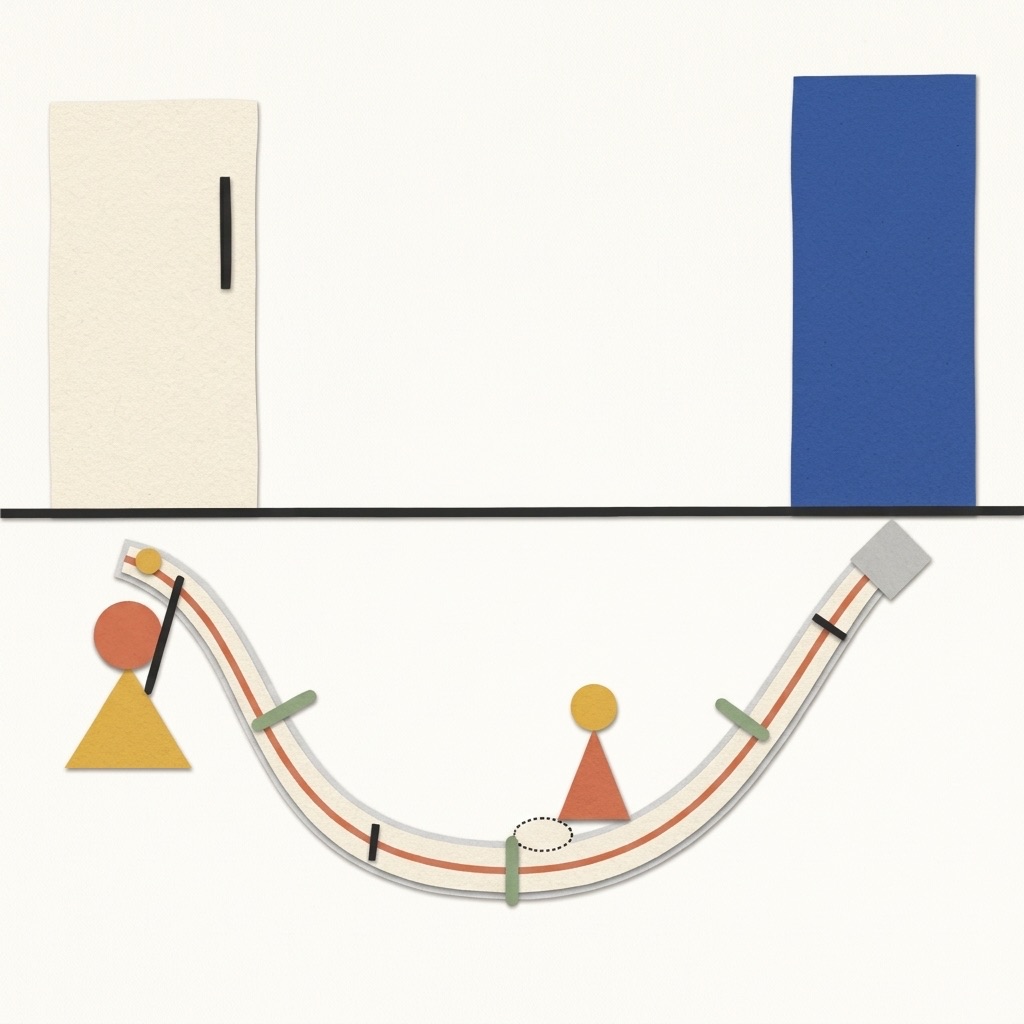
By Monday evening, the paper snake stretched from the fridge to the back door. It was a timeline of AI, taped together sheet by sheet, for a school project due on Friday.
Mia stepped over it in her fluffy slipper, the one a tablet had once called a cat.
'The head is now,' said Leo. 'The tail is 1843.'
At the tail: Ada Lovelace, London. She wrote notes about Charles Babbage's planned Analytical Engine, which was never built. She imagined it working with more than numbers, even composing music.
'Why didn't they build it?' asked Mia.
'I don't know yet.' Leo drew a question mark.
Dad looked up. 'Ada also said it could only do what we know how to order it to do.'
'So it could only do what it was told,' said Leo.
'Wish you two worked like that,' said Dad. 'I say "tidy up" and nothing happens.'
Leo added a gold star: Our London.
Further along: 1950, Alan Turing. After codebreaking at Bletchley Park in the Second World War, he wrote a paper that opened with a question: 'Can machines think?'
'Can they?' asked Mia.
'He swapped the question for a game,' said Leo. 'The imitation game. You type questions to someone you can't see. Can you tell if the replies come from a machine or a person?'
Mia pointed at the kitchen speaker. 'That one said good morning at midnight.'
'Easy to tell. Fail,' said Leo, and wrote it in the margin.
'In that paper, Turing argued with Ada's idea that machines can only do what they're told,' said Dad. 'He called it "Lady Lovelace's Objection".'
Leo drew an arrow from 1950 all the way back to 1843.
Next came a line he'd got from a chatbot: 1956, the name 'artificial intelligence'.
Mia crouched over it. 'How do you know?'
'A chatbot told me.'
'The kind that gave you a tadpole girl on Tower Bridge?'
Leo put the pen down.
Leo dug out the fat library book about computers that he'd borrowed and never opened, and flicked to the index. 'Found it.'
The name 'artificial intelligence' was first written in a proposal dated 1955, by John McCarthy and others, asking for a summer workshop at Dartmouth College in the USA. The workshop ran the next summer, in 1956.
'So the chatbot was wrong,' said Mia, delighted.
'And I didn't check,' said Leo. He crossed out the line and wrote two: 1955, the name. 1956, the workshop.
Next: 1966, ELIZA, by Joseph Weizenbaum at MIT. ELIZA matched patterns in what people typed. Mention your mother, and it might ask you to tell it more about your family.
'That's kind,' said Mia.
'It's just matching words,' said Leo. 'Some people felt it understood them. It didn't.'
Two blue patches: AI winters, mid-1970s and late 1980s into the early 1990s.
'Did it snow?' asked Mia.
'No. Fewer people were excited, and there was less money for research.'
By Wednesday the snake had reached the hall, and the tape ran out. Worse, it was already far longer than the classroom wall.
Leo kept going: games.
1996: Garry Kasparov, world chess champion, beats IBM's computer Deep Blue. 1997: rematch. Deep Blue wins.
'Why did it win the second time?' asked Mia.
Leo frowned. 'Don't know yet.' Another question mark.
Around 2012, neural networks trained on huge numbers of example pictures got much better at recognising what's in a photo.
'So why did a tablet call my slipper a cat?'
'Much better isn't perfect.'
Then Go. Go has far more possible games than chess, and lots of people expected computers wouldn't win for a long time. In March 2016, AlphaGo, made by DeepMind in London, beat Lee Sedol, one of the world's best players, four games to one, in Seoul.
Another gold star: Our London.
Leo looked at the empty tape roll. Two days left.
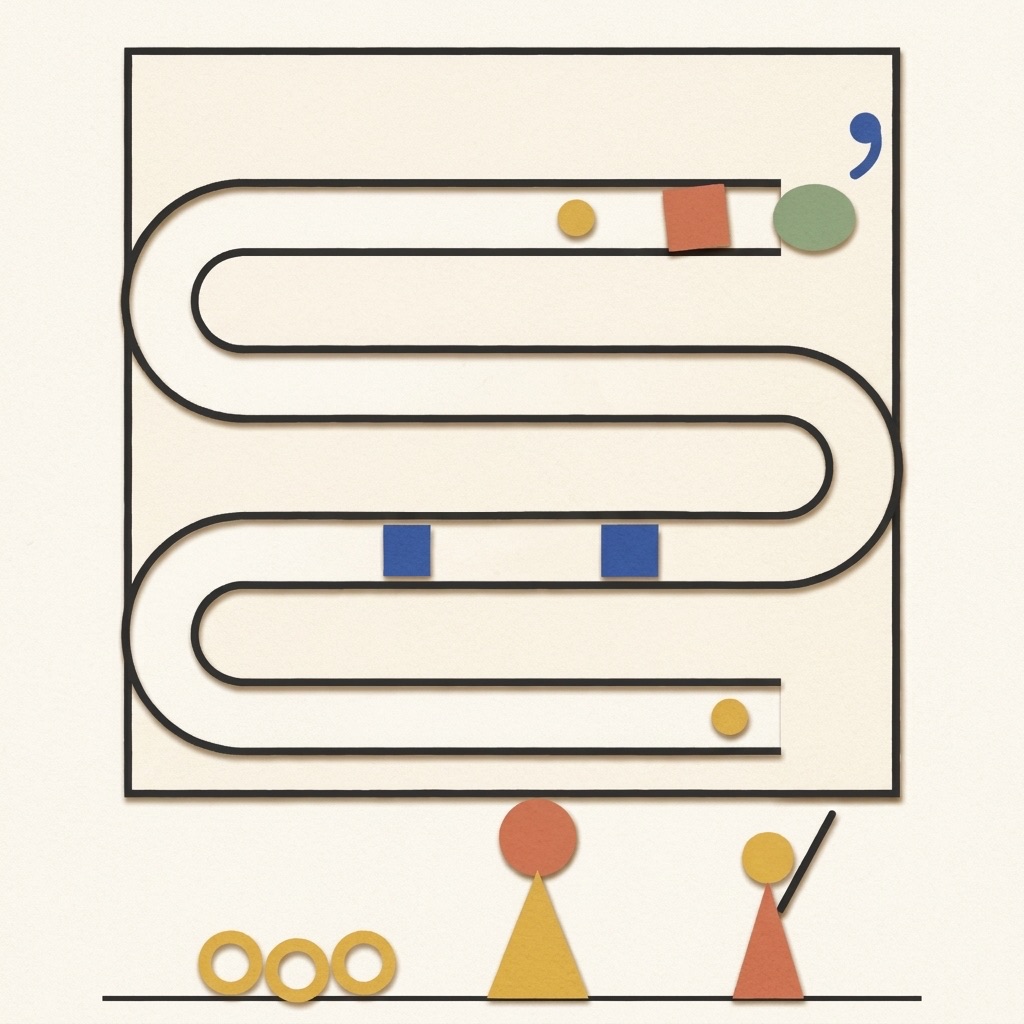
On Thursday night Leo reached the head of the snake. Since about 2022: chatbots, widely used. They first learn to predict likely next words from enormous amounts of text, then get more training from people's ratings of their answers. They still don't check whether what they say is true.
Dad came home with three new rolls of tape.
'It's still too long for the wall,' said Leo.
Mia studied it. 'Snakes curl up.'
So they folded it into big S-bends: 1843 at the bottom, now at the top, two honest question marks in between. Folded, it was exactly wall-sized. Ready for Friday.
Then Mia took a felt-tip and wrote one last note by 2022, in wobbly capitals: HOW DO YOU KNOW?
'Specially,' she said, 'if it tells you to put jam and sprinkles on fish fingers.'
What would you put on the snake after 2022?